 kengdevLet’s talk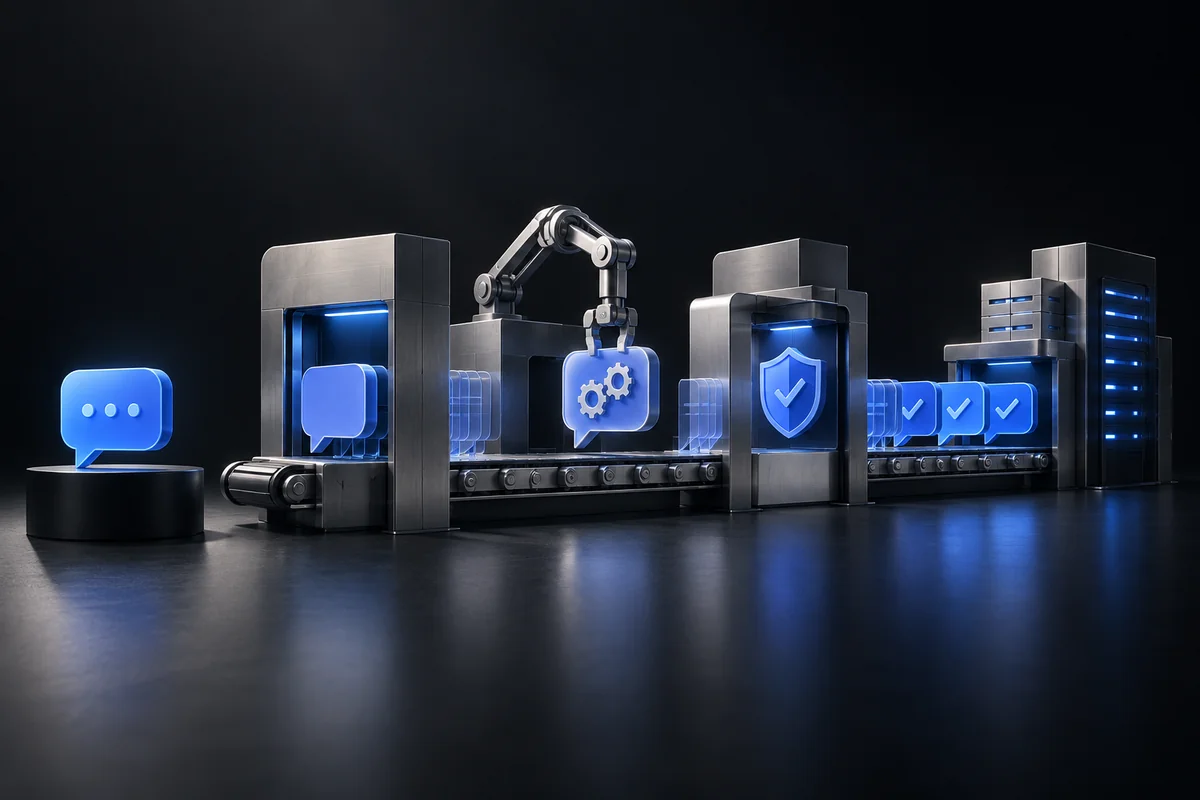
Updated on 2026-09-10
AI automation has a chain of tasks executed by a system that understands language, where classic automation follows rules written in advance. Two things identify it: it runs without being triggered by hand, and it leaves a trace of what it did.
Move past isolated chat and wire AI into a flow that runs on its own, with guardrails and a usable trail.
An automation with no baseline is unverifiable. Count the volume and the time before you wire anything up.
Four industrialization stages
Before talking about models, look at the process. If you cannot measure the time lost, the agent will not help.
Industrialization then goes through four stages:
- Individual chat (IDE sidebar, ChatGPT), with no audit and no continuity
- Shared prompts and scripts, with minimal conventions
- Tooled agents (MCP, API) integrated in the workflow
- Replayable pipelines (CI, ops queues), with logs, HITL and clear ownership
Some teams go from the sidebar to dozens of skills and thousands of lines of versioned context this way. At that point, it is an internal product, not a gadget.
AI automation vs first business agent
The how to create an AI agent guide covers support, follow-ups and inbound, in other words the SME business flow.
This article covers something else: industrializing AI in the software lifecycle (SDLC) and technical ops. The physics of agents stays the same, but the sponsor and the KPI change.
Mixing both on one page would create SEO cannibalization and confusion for the reader.
CI/CD, DevOps and guardrails
A single flow from dev to prod cuts context switching, as long as the merge guardrails stay. For headless agents in CI, enforce isolation, secrets never in the clear, and a maximum number of turns.
Integrated DevOps suites, like assistants in the forge, help if the team policy is already written. The tool does not replace the convention.
AI is easy to adopt; the protections (tests, review, context segmentation, good prompts) are much less so. Set the guardrails along with adoption, not six months later.
ROI and governance
The ROI computes simply: time saved multiplied by loaded cost, minus LLM usage, integration, HITL and incidents. Without that formula, no serious trade-off is possible.
Governance fits in five elements:
- A named owner
- A token budget
- An action allowlist
- A data policy
- A quarterly review of use cases, with a kill list for the zombies
For tech watch, keep a stable stack and one or two scoped experiments. That beats tool zigzag, without the FOMO.
Launching an automation pilot in 60 days
The plan fits in 60 days:
- Days 1-15: audit 3 technical or ops processes, score them and pick a pilot.
- Days 16-45: prototype the pipeline with HITL and metrics.
- Days 46-60: decide the go / no-go.
Without the third brick (control), you just have a POC or a demo.
If you want to prioritize the flow that pays in delivery, we can scope the approach in 20-40 minutes.
Frequently asked questions
Difference vs first SME agent?
The first agent covers a business flow, like support or sales. Here, we industrialize AI in the dev cycle and the pipelines.
Are Make/Zapier enough?
For a deterministic flow, yes. As soon as natural language enters, you need an agent with guardrails, optionally orchestrated through an iPaaS.
How many processes in year one?
One to three processes done well beat ten half-finished integrations. Automation debt is real too.
Agency or internal build?
Build internally if you have the ownership and the APIs. A partner mostly helps scope and speed up integration of the first AI pipeline.
Avoid shelfware?
Set the KPI before the build, keep the pilot short with a go / no-go, name an owner and train the team.
Sources and references
- Building effective agentsAnthropic
Primary documentation for product capabilities and changes.