 kengdevLet’s talk
LLMOps covers the practices that keep language models running in production: versioning prompts, measuring answer quality with automated evaluations, tracing every call, and watching cost as closely as latency. It takes DevOps logic and applies it to a system whose output is not deterministic.
Move from a POC that works in a demo to a service whose quality you can prove week after week.
Without an evaluation set, you cannot tell whether your last prompt change improved the product or broke it.
LLMOps: production for token systems
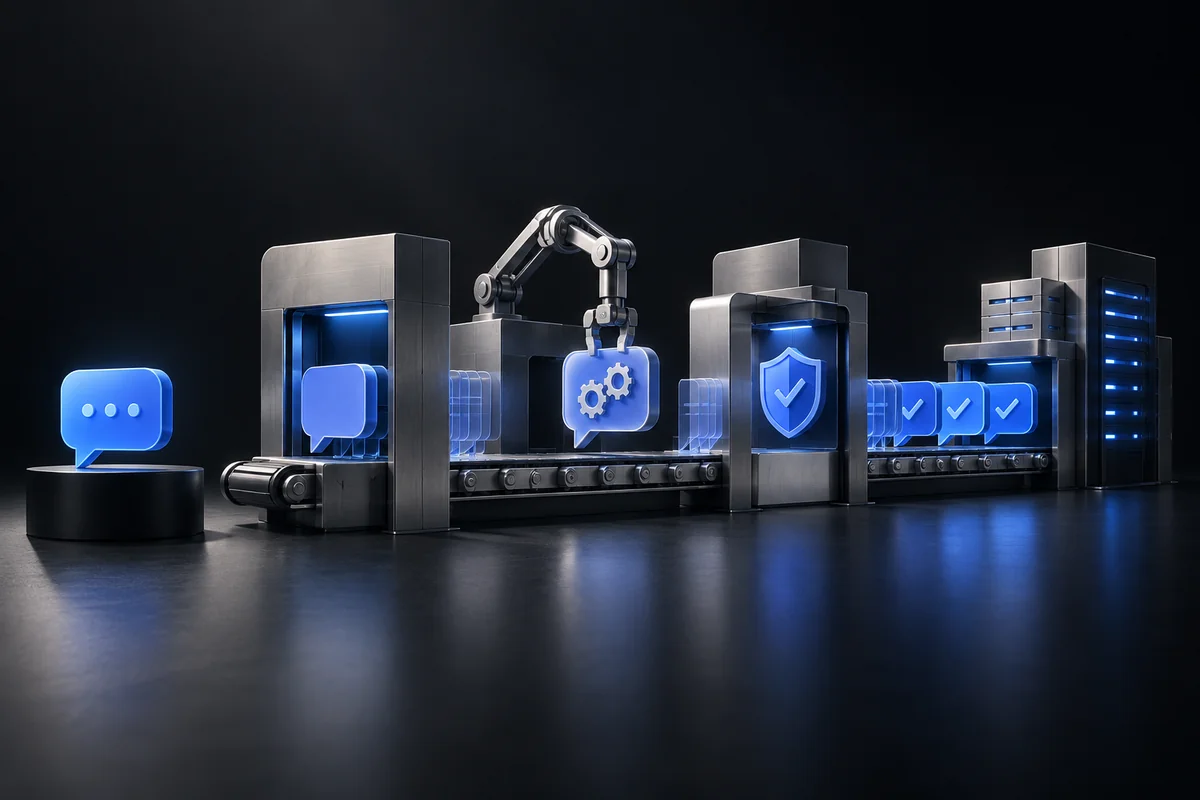
LLMOps covers the practices used to build, deploy, observe and improve LLM-based applications. In practice, it means fewer "AI strategy" slides and more replayable pipelines: versioned prompts, evals, logs, budgets and incident handling.
The difference with classic tabular MLOps comes down to the object. The output is language, so it is fuzzy. The cost is often counted per token. External dependencies (model APIs, tools, MCP) move outside your control. And the "dataset" is sometimes a living document corpus.
Without LLMOps, every dev keeps a prompt in a pad, the surprise bill lands at the end of the month, and nobody can explain why quality dropped on Tuesday.
Eval: the only compass
To steer an LLM system, you need three complementary evaluation layers:
- Offline unit tests: gold cases and deterministic assertions on the JSON or the structure
- Bounded LLM judges, with healthy distrust and a human-reviewed sample
- Online monitoring: thumbs, human edits and incidents
Start small, with 30 critical business cases, and block the merge as soon as regression exceeds a threshold. A model that is "better on a public bench" but breaks your 30 cases is not an upgrade.
For a RAG, separate the retrieval eval from the generation eval. For an agent, evaluate the full trajectory (the tools it called), not only the final text.
Versioning: prompts, models, tools
Everything that changes the system's behavior deserves a versioned identifier:
- The system prompt and the skills
- Parameters such as temperature
- The model, pinned to a precise snapshot
- The tools and MCP servers
- The RAG corpus
Log those identifiers on every request. And ban "we changed the prompt in prod without a ticket": a prompt follows the same discipline as code, with a PR, a review and a possible rollback.
Feature flags complete the setup: you enable a new prompt on 5% of traffic, or on an internal workspace, before going to 100%.
Observability and cost
Traces are the base of debugging. Record retrieve, generation and tool latency, tokens in and out, provider errors and retries, with OpenTelemetry when you can. Without traces, debugging an agent amounts to reading logs at random.
The budget needs steering too: set a ceiling per team, per project and per day, with alerts and dashboards. Multi-agents and ultra modes multiply context windows, so cost is no longer linear with "one chat".
On online quality, track the human edit rate, the rejects and the AI-related support tickets. Those are your real KPIs, not the vendor leaderboard.
Guardrails and deployment
Guardrails cover most of the risk:
- Schema validation on outputs
- PII filters
- A tool allowlist
- Human review (HITL) on risky actions
- A sandbox for execution
For supervision design, lean on the human-in-the-loop guide. On the deployment side, separate environments (dev, staging, prod), keep secrets out of the code, and set timeouts and circuit breakers to absorb provider lags. An agent without a timeout is an open bill.
Finally, prepare two incident runbooks: one for a "quality drop" (last change, logs, prompt or model rollback) and one for a "cost spike" (top routes, multi-agent, tool loops).
Minimal LLMOps for an SME (checklist)
The base fits in seven points:
- One owner is named for the AI system
- 30 eval cases run in CI
- Prompts and models are pinned
- Logs and traces cover 100% of prod traffic
- A token budget exists, with an alert
- Human review protects risky actions
- A weekly 30-minute review tracks quality and cost
An enterprise LLMOps platform can wait. What matters on day 1 is writing these seven points down and keeping them.
If you want to set an LLMOps base on a real agent or RAG, we can scope it together in 20-40 minutes.
Frequently asked questions
What is LLMOps?
LLMOps covers the practices used to operate LLM applications in production: evals, versioning, observability, cost tracking, guardrails, deployment and incident handling.
LLMOps vs MLOps?
Both share the same spirit of reproducibility and monitoring, but the object changes: LLMOps deals with language, tokens, prompts, external tools and document corpora rather than tabular features alone.
Where should SMEs start?
Start with a 30-case eval, a pinned model and prompt, and token logs. Then add human review and a budget. The platform comes after the discipline.
Do we need a paid LLMOps platform?
Not on day 1. Existing tools (CI, OpenTelemetry, log tables) are enough to get started. Buy a platform when volume or compliance requires it.
How do RAG and LLMOps link?
A RAG needs a retrieval eval, corpus versioning and freshness monitoring. LLMOps provides the frame, and the RAG LLM guide details the pipeline.
Do multi-agents change LLMOps?
Yes: they add traces, tokens and failure modes. Hop and tool ceilings become mandatory. The multi-agents guide and the coding-agent controls news dig deeper.
Sources and references
- Hidden Technical Debt in Machine Learning SystemsSculley et al., NeurIPS
Why the model is the smallest part of the system. Written long before LLMs, and still accurate today.
- Service Level Objectives (Site Reliability Engineering)Google
How to set thresholds a team can actually hold. Transpose it onto latency and the share of answers accepted.
- Semantic conventions for generative AI systemsOpenTelemetry
The standard vocabulary for tracing model calls without locking yourself into one observability vendor.